The following excerpts and image(s) are authorized to be shared under the Creative Commons Attribution ShareAlike License.
For the original full text, please go to: “Tofu” on Wikipedia.
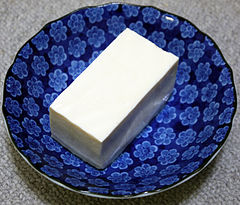
Tofu
Tofu or bean curd[3] is a food made by coagulating soy milk and then pressing the resulting curds into soft white blocks. It is of Chinese origin,[4] and it is also a part of East Asian and Southeast Asian cuisine such as Chinese, Japanese, Korean, Indonesian, Vietnamese,[5] and others.[6]
[…]
Tofu is thought to have originated in ancient China,[4] but its precise origins are debated. Tofu and its production technique were introduced into Korea and then Japan[7][8][9] during the Nara period. It also spread into other parts of East Asia as well.[10] This spread likely coincided with the spread of Buddhism because it is an important source of protein in the vegetarian diet of East Asian Buddhism.[7]
[…]
Tofu contains a low amount of calories, relatively large amount of iron, and little fat. Depending on the coagulant used in manufacturing, the tofu may also be high in calcium and/or magnesium.
Etymology
The English word “tofu” comes from the Japanese tōfu (豆腐), which itself derives from the Chinese dòufu (豆腐 or 荳腐) from “bean” (豆) plus “curdled” or “fermented” (腐).[12][13]
The English term “bean curd(s)” for tofu has been used since at least 1840.[14]
Production
|
tofu (raw) |
|
| Nutritional value per 100 g (3.5 oz) | |
| Energy | 318 kJ (76 kcal) |
| Carbohydrates | 1.9 g |
| Fat | 4.8 g |
| – saturated | 0.7 g |
| Protein | 8.1 g |
| Calcium | 350 mg (35%) |
| Iron | 5.4 mg (43%) |
| Magnesium | 30 mg (8%) |
| Sodium | 7 mg (0%) |
| Percentages are relative to US recommendationsfor adults. Source: USDA Nutrient database |
|
Tofu is made by coagulating soy milk and pressing the resulting curds. Although pre-made soy milk may be used, most tofu producers begin by making their own soy milk, which is produced by soaking, grinding, boiling and straining dried (or, less commonly, fresh) soybeans.
Coagulation of the protein and oil (emulsion) suspended in the boiled soy milk is the most important step in the production of tofu. This process is accomplished with the aid of coagulants. Two types of coagulants (salts and acids) are used commercially.[15] The third type of coagulant, enzymes, is not yet used commercially but shows potential for producing both firm and “silken” tofu.
[…]
Varieties
There is a wide variety of tofu available in both Western and Eastern markets. Despite the daunting variety, tofu products can be split into two main categories: fresh tofu, which is produced directly from soy milk, and processed tofu, which is produced from fresh tofu. Tofu production also creates important side products which are often used in various cuisines.
Fresh Tofu
Depending on the amount of water that is extracted from the tofu curds, fresh tofu can be divided into three main varieties. Fresh tofu is usually sold completely immersed in water to maintain its moisture content.
Soft/Silken Tofu
Soft/silken tofu is undrained tofu that contains the highest moisture content of all fresh tofus.[20] Its texture can be described as similar to that of very fine custard. In Japan and Korea, traditional soft tofu is made with seawater.[21][22][23][24][25]
Douhua ,or tofu brain, often eaten as a dessert, but sometimes with salty pickles or hot sauce added instead, is another type of soft tofu with an even higher moisture content. Because it is nearly impossible to pick up this type of tofu with chopsticks, it is generally eaten with a spoon.
Some variation exists among soft tofus. Black douhua (黑豆花) is a type of silken tofu made from plain black beans and soybeans, which is usually made into dòuhuā (豆花) rather than firm or dry tofu. The texture of black bean tofu is slightly more gelatinous than regular douhua and the color is greyish in tone. This type of tofu is eaten for the earthy “black bean taste.” Edamame tofu is a Japanese variety of kinugoshi tōfu made from edamame (fresh green soybeans); it is pale green in color and often studded with whole edamame.
Firm Tofu
Firm tofu: Although drained and pressed, this form of fresh tofu still contains a great amount of moisture. It has the firmness of raw meat but bounces back readily when pressed.
In some places in Japan, a very firm type of momendofu is eaten, called ishi-douhu{石豆腐 (literally stone tofu)} Some of these tofu are able to be tied by rope for carrying, because of their firmness.[citation needed] These types of firm tofu are produced by using seawater instead of nigari (magnesium chloride), or using concentrated soy milk. These products are produced in areas where the travel is inconvenient, such as remote islands, mountain villages, heavy snowfall areas, and so on.
Chinese “Dry Tofu”
Dòu gān (豆干, literally “dry tofu” in Chinese) has not, despite its name, actually been dried but is rather an extra firm variety of tofu with a large amount of liquid pressed out of it. Dòu gān contains the least amount of moisture of all fresh tofu and has the firmness of fully cooked meat and a somewhat rubbery feel similar to that of paneer. Western firm tofu is milled and reformed after the pressing and sometimes lacks the skin with its cloth patterning. One variety of dried tofu is pressed especially flat and sliced into long strings with a cross section smaller than 2 mm × 2 mm. Shredded dried tofu, which looks like loose cooked noodles, can be served cold, stir-fried, or similar in style to Japanese aburaage.[26][27]
Processed Tofu
Many forms of processed tofus exist, due to the varied ways in which fresh tofu can be used. Some of these techniques likely originate from the need to preserve tofu before the days of refrigeration, or to increase its shelf life and longevity. Other production techniques are employed to create tofus with unique textures and flavors.[28]
Fermented
- Pickled tofu: Also called “preserved tofu” or “fermented tofu,” this food consists of cubes of dried tofu that have been allowed to fully air-dry under hay and slowly ferment from aerial bacteria.[28] The dry fermented tofu is then soaked in salt water, Chinese wine, vinegar, and minced chiles, or a unique mixture of whole rice, bean paste, and soybeans. And in Japan, pickled tofu with miso paste is called ‘tofu no misodzuke’, which is a traditional preserved food in Kumamoto.
- Stinky tofu: A soft tofu that has been fermented in a unique vegetable and fish brine.[28] The blocks of tofu smell strongly of certain pungent cheeses, and are described by many as rotten and fecal. Despite its strong odor, the flavor and texture of stinky tofu is appreciated by aficionados, who describe it as delightful. The rind that stinky tofu develops from frying is said to be especially crisp, and is usually served with soy sauce, sweet sauce, and/or hot sauce.
Flavored
Flavors can be mixed directly into curdling soy milk while the tofu is being produced.
Sweet: Common sweet dessert tofus include peanut tofu, mango tofu, coconut tofu and longan tofu. Most sweet tofus have the texture of silken tofu and are served cold. Products called “almond tofu” in some cases are actually not tofu but are instead gelatinous mixtures including agar or gelatin and whitened with milk or coconut milk. In Japan these are canned with syrup and sold as sweet desserts.
Savory: Egg tofu is the main type of savory flavored tofu. Whole beaten eggs are filtered and incorporated into the soy milk before the coagulant is added. Egg tofu has a pale golden color that can be attributed to the addition of egg and, occasionally, food coloring. This tofu has a fuller texture and flavor than silken tofu, which can be attributed to the presence of egg fat and protein.
Dried Tofu
Two kinds of dried tofu are produced in Japan. They are usually rehydrated (by being soaked in water) prior to consumption. In their dehydrated state they do not require refrigeration.
Koya tofu (also known as shimidofu) is made using nigari.
Kori tofu (literally “frozen tofu” is freeze-dried.[30]
Fried
With the exception of the softest tofus, all forms of tofu can be fried. Thin and soft varieties of tofu are deep fried in oil until they are light and airy in their core.
Tofus such as firm Asian and dòu gān (Chinese dry tofu), with their lower moisture content, are cut into bite-sized cubes or triangles and deep fried until they develop a golden-brown, crispy surface. These may be eaten on their own or with a light sauce, or further cooked in liquids; they are also added to hot pot dishes or included as part of the vegetarian dish called luohan zha
Aburaage (油揚げ): Japanese thin fried tofu for Inari-sushi.
Atsuage (厚揚げ): The thicker variety of fried tofu. It is also called namaage.
Frozen
Thousand layer tofu: By freezing tofu, the large ice crystals that develop within the tofu result in the formation of large cavities that appear to be layered. The frozen tofu takes on a yellowish hue in the freezing process. Thousand layer tofu is commonly made at home from Asian soft tofu though it is also commercially sold as a specialty in parts of Taiwan. This tofu is defrosted, and sometimes pressed to remove moisture, prior to use.
Koyadofu: The name comes from Mount Koya, a center of Japanese Buddhism famed for its shōjin ryōri, or traditional Buddhist vegetarian cuisine. It is sold infreeze-dried blocks or cubes in Japanese markets. It must be soaked in water before eating, and is typically simmered in dashi, sake or mirin and soy sauce. A similar form of freeze-dried tofu, in smaller pieces, is found in instant soups (such as miso soup), in which the toppings are freeze-dried and stored in sealed pouches.
Tofu is also a main dish, especially this type which is commonly used and is in high demand in eastern Asia.
For “Byproducts” and “Preparation”, visit: “Tofu” on Wikipedia.
History
Tofu originated in ancient China,[4] although little else is known about the exact historic origins of tofu and its method of production. While there are many theories regarding tofu’s origins, historical information is scarce enough as to relegate the status of most theories to either speculation or legend. Like the origins of cheese and butter, the exact origin of tofu production may never be known or proven.
What is known is that tofu production is an ancient technique. Tofu was widely consumed in ancient China,[citation needed] and techniques for its production and preparation were eventually spread to many other parts of Asia.
For “Three Theories of Origin”, please visit: “Tofu” on Wikipedia.
Nutrition and Health Information
Protein
Tofu is relatively high in protein, about 10.7% for firm tofu and 5.3% for soft “silken” tofu with about 5% and 2% fat[40] respectively as a percentage of weight.[41]
In 1995, a report from the University of Kentucky, financed by The Solae Company St. Louis, Missouri (the PTI division of DuPont), concluded that soy protein is correlated with significant decreases in serum cholesterol, Low Density Lipoprotein LDL (bad cholesterol) and triglyceride concentrations.[42] However, High Density Lipoprotein HDL (good cholesterol) did not increase. On the basis of this research, PTI, in 1998, filed a petition with Food and Drug Administration for a health claim that soy protein may reduce cholesterol and the risk of heart disease.
The FDA granted this health claim for soy: “25 grams of soy protein a day, as part of a diet low in saturated fat and cholesterol, may reduce the risk of heart disease.”[43] For instance, 100 grams of firm tofu contains 15.78 grams of soy protein.[44] In January 2006, an American Heart Association review (in the journal Circulation) of a decade-long study of soy protein benefits showed only a minimal decrease in cholesterol levels, but it compared favorably against animal protein sources.[45]
Isoflavones
Soy isoflavones have not been shown to reduce post menopause hot flashes in women or to help prevent cancers of the breast, uterus or prostate. Thus, soy isoflavone supplements in food or pills are not recommended.[46]
A study done by the Pacific Health Research Institute followed over 3000 Japanese men between 1965 and 1999, which showed a positive correlation between cerebral atrophy and consumption of tofu.[47] According to the Alzheimer’s Research Trust, more research is needed.[48]
Health Issues
High consumption of tofu has been linked with dementia in older age groups in more than one study, whereas in younger and middle-age age groups it might actually protect the brain. It has been stressed that there is no evidence that eating tofu in moderation can cause any problems, and that further research is needed to confirm both the negative as well as the positive effects.[48]
For “Sales and Distribution”, please visit: “Tofu” on Wikipedia.
 This blog may soon be moved to another site.