The following article and image(s) are authorized to be shared under the Creative Commons Attribution ShareAlike License.
For the original full text, please go to: “Apple II Plus” on Wikipedia.
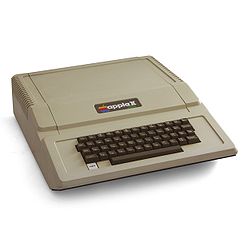 The Apple II Plus (stylised as Apple ][ ) was the second model of the Apple II series of personal computers produced by Apple Computer, Inc. It was sold new from June 1979 to December 1982.[1]
Features
The Apple II Plus had a total of 48 KB of RAM, expandable to 64 KB by means of the Language Card, an expansion card that could be installed in the computer’s slot 0. The Apple’s 6502microprocessor could support a maximum of 64 KB of memory, and a machine with 48KB RAM reached this limit because of the additional 16 KB of read-only memory and I/O addresses. For this reason, the extra RAM in the language card was bank-switched over the machine’s built-in ROM, allowing code loaded into the additional memory to be used as if it actually were ROM. Users could thus load Integer BASIC into the language card from disk and switch between the Integer and Applesoft dialects of BASIC with DOS 3.3‘s INT and FP commands just as if they had the BASIC ROM expansion card. The Language Card was also required to use LOGO, Apple Pascal, and FORTRAN 77. Apple Pascal and FORTRAN ran under a non-DOS operating system based on UCSD P-System, which had its own disk format and included a “virtual machine” that allowed it to run on many different types of hardware.
The Apple II Plus included the Applesoft BASIC programming language in ROM. This Microsoft-authored dialect of BASIC, which was previously available as an upgrade, supported floating-point arithmetic (though it ran at a noticeably slower speed than Steve Wozniak’s Integer BASIC) and became the standard BASIC dialect on the Apple.
Like the Apple II, the Apple II Plus had no lowercase functionality. All letters from the keyboard were upper-case, there was no caps lock key, and there were no lowercase letters in the text-mode font stored in the computer’s ROM. To display lowercase letters, some applications would run in the slower hi-res graphics mode and use a custom font, rather than running in the fast text mode using the font in ROM. Other programs, primarily those where both capitalization and text movement were important, such as word processors, used inverse text mode to represent text that would be lowercase when printed. Alternatively, users could install a custom ROM chip that contained lowercase letters in the font, or purchase one of several third-party 80-column cardsthat enabled a text mode that could display 80-column, upper- and lower-case text. The “Videx Videoterm” card and its many clones were especially popular. For lowercase input, since it was not possible to detect whether the keyboard’s Shift keys were in use, a modification called the “one-wire shift key mod” connected the Shift key to one of the pins on the motherboard’s paddleconnector. Compatible applications, including nearly all word processors, could then detect whether the shift key was being pressed. This modification, however, involved adding wires inside the Apple II, and was therefore only popular among hobbyists. For this reason, most applications that could support lower-case letters could also use the ESC key as a substitute lowercase toggle if the “shift key mod” was not installed. The II Plus had a plastic case with brass mesh running along the inside of the case. This mesh protected the computer from harmful radio frequency energy. Small grids of plastic pins, and sometimes Velcro, was used to hold the case’s top onto the computer.
Furthermore, the Apple II Plus, like its predecessor the Apple II, had a repeat key built into its keyboard. The key was labeled “REPT” and was located just to the left of the Enter key.[2][3] The repeat key had a stiffer spring than the rest of the keyboard, which made it more difficult to press by accident. The II Plus was the last Apple Computer to have this key, as later Apple computers would incorporate the ability to hold down a key for a period of time to repeat the key.
Apple II Europlus and J-Plus
After the success of the first Apple II in the United States, Apple expanded its market to include Europe and the Far East in 1978, with the Apple II Europlus (Europe) and the Apple II J-Plus(Japan). In these models, Apple made the necessary hardware, software and firmware changes in order to comply to standards outside of the US. The power supply was modified to accept the local voltage, and in the European model the video output signal was changed from color NTSC to monochrome PAL — an extra video card was needed for color PAL graphics, since the simple tricks Wozniak had used to generate a pseudo-NTSC signal with minimal hardware didn’t carry over to the more complex PAL system. In the Japanese version of the international Apple, the keyboard layout was changed to allow for Katakana writing (full Kanji support was clearly beyond the capabilities of the machine), but in most other countries the international Apple was sold with an unmodified American keyboard; thus the German model still lacked the umlauts, for example. For the most part, the Apple II Europlus and J-Plus were identical to the Apple II Plus. Production of the Europlus ended in 1983.
Bell & Howell
The Apple II Plus was also sold by Bell & Howell specifically to educational markets under special license from Apple. The normal consumer Apple II Plus was not UL-listed because the top could be opened; the B&H model was the same as the consumer version sold by Apple except that it came in a black case, which could not be as easily opened, and a special A/V package allowing it to be sold as audio/visual equipment. Bell & Howell packaged the unit with optional “back packs” that offered various inputs and outputs for A/V equipment to easily interface with the II Plus.[4][unreliable source?] This was the only black computer Apple would manufacture until the Macintosh TV in 1993.
Military applications
A TEMPEST-approved version of the Apple II Plus called the Microfix was developed in 1980 by the Georgia Tech Research Institute for U.S. Army FORSCOM. Fielded in 1982, the Microfix system was the first tactical system using video disk (Laserdisc) map technology providing zoom and scroll over map imagery coupled with a point database of intelligence data such as order of battle, airfields, roadways, and bridges.[5][6][7]
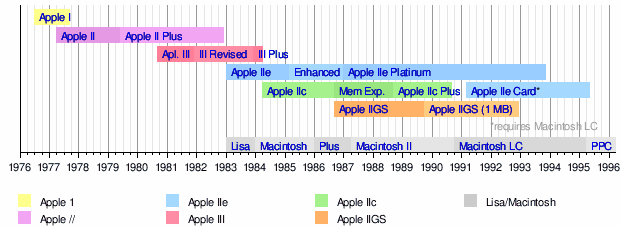
Timeline of Apple II family models
See also: Timeline of Apple II family
 This blog may soon be moved to another site.
Your style is really unique compared to other folks I’ve read stuff from.
Thank you for posting when you have the opportunity, Guess I’ll just bookmark this page.